Case Study / Application System + Workflow Strategy
Building a Scholarship Application System on a Tight Timeline
A scholarship application system for the Foundation for US Women in Optics that transformed a complex, multi-step process into a clearer workflow for applicants, references, reviewers, and board members.
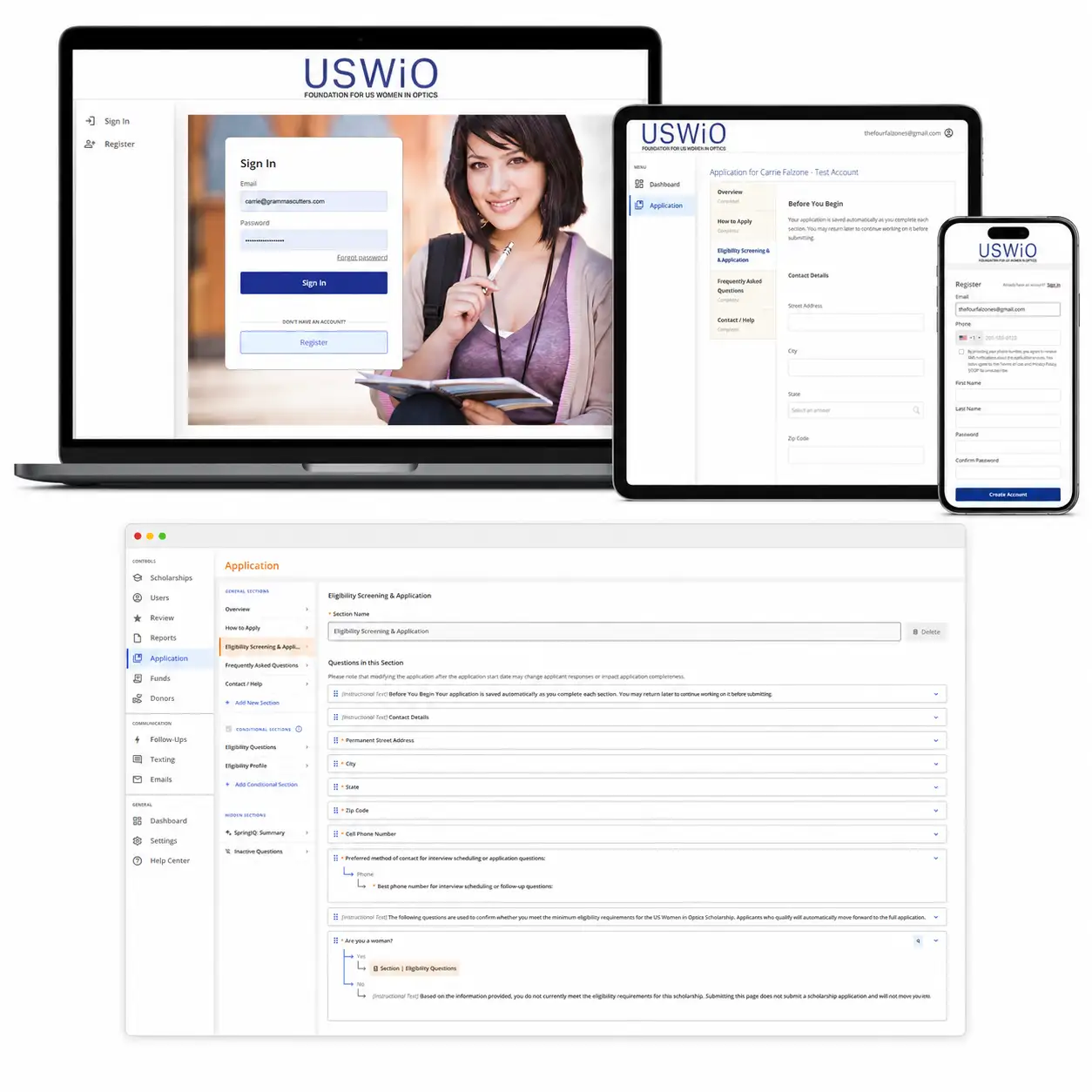
More than an application form — a complete scholarship workflow.
When the Foundation for US Women in Optics set out to launch a new scholarship program, they needed more than a simple online application. They needed a system that could support eligibility screening, applicant submissions, transcripts, resumes, financial documentation, reference requests, board review, interviews, and award acceptance — all within a compressed timeline.
What started as a request for a scholarship application website quickly became a larger workflow, content, platform, and communications project. The goal was not just to get something live, but to create a system applicants could navigate clearly, references could respond to easily, and board members could use confidently during review and selection.
Vertical Insite supported workflow planning, content development, platform coordination, privacy-policy guidance, testing, and launch support for an accelerated 2026 scholarship cycle.
The program, process, and platform all had to come together quickly.
The Foundation was launching a brand-new scholarship, which meant the process itself was still being defined while the system was being built. The board needed to make decisions about eligibility, references, document uploads, privacy-policy language, scoring, interviews, notifications, and award acceptance — all while staying on track for launch.
There was also an important strategic decision to make early on: whether to build a custom website-based system or use a scholarship platform. That decision had to be based on actual requirements, timeline realities, applicant needs, board review needs, and privacy considerations.
- The scholarship process was still being defined while the system was being built
- Applicants needed clear guidance around eligibility, materials, deadlines, and submission steps
- References needed a structured way to respond
- Board members needed a workable review and scoring process
- The system needed to handle sensitive documents and privacy-policy language
- The project had to launch within a compressed timeline
Create a clear, usable system for every stage of the scholarship journey.
- Compare platform options against the Foundation’s actual requirements
- Map the applicant journey from eligibility through submission
- Clarify reference request language and response expectations
- Support board review, scoring, interviews, and award acceptance planning
- Develop instructional content, helper text, FAQ language, and notifications
- Support privacy-policy guidance for transcripts, financial documents, recommendations, and applicant materials
- Test the system across desktop and mobile before launch
Map the process before building the pieces.
The project was approached as both a user-experience challenge and a process-design challenge. The first step was to map the full scholarship journey from beginning to end: what applicants needed to see and understand, what references needed in order to respond successfully, and what the board needed in order to review applications consistently.
Because this was a new program, the strategy also involved helping the board clarify its own process. A detailed build worksheet served as both a roadmap for the platform provider and a decision-making tool for the board.
That worksheet included the application flow, field structure, helper text, notifications, FAQ content, privacy-policy considerations, deadlines, reference-request language, and board review planning.
“The work was not just about launching an application. It was about turning a new, complicated process into a system people could understand and use.”
A complete application workflow built around applicants, references, and reviewers.
The final system was built to support a complete scholarship workflow rather than a single submission form. Applicants begin with an eligibility section that confirms whether they meet the minimum qualifications before moving into the full application.
- Created a structured eligibility section before the full application
- Supported contact information, academic details, enrollment information, and personal statement fields
- Included transcript, resume, and financial documentation uploads
- Built required reference request and response workflows
- Developed section introductions, helper text, upload instructions, and submission messaging
- Created missing-field guidance, reference reminders, and explanations of next steps
- Supported review, scoring, interview planning, finalist selection, and award acceptance workflow planning
Privacy-policy development was also an important part of the project. Because the system was collecting transcripts, financial aid documents, personal statements, and recommendation materials, the Foundation needed launch-ready privacy language that was clear, practical, and aligned with how the platform and review process actually worked.
Beyond the form itself, Vertical Insite supported repeated desktop and mobile testing, language and usability review, platform coordination, live settings, deadline confirmation, domain redirection, and a walkthrough video showing how applicants, references, and administrators would interact with the system.
A functional scholarship system with a process the Foundation can build on.
A working scholarship application system launched within the Foundation’s compressed timeline.
The result was a scholarship application system that gave the Foundation a real operational process — not just a page to collect submissions. Applicants now have a clearer path through eligibility, required materials, references, deadlines, and submission status.
References have a structured way to respond, and the board has a stronger foundation for reviewing applicants in a more organized and transparent way. Just as importantly, the Foundation now has a framework it can continue to build on in future scholarship cycles.
“This project is a good example of how many website-related projects are really part strategy, part messaging, part user experience, part systems thinking, and part coordination.”
Client Feedback
A working scholarship application system delivered within the timeframe.
“I’m on a foundation board that needed a scholarship application website built in a month. I approached Carrie Falzone at Vertical Insite because she built attractive and functional websites for my small businesses in the past. She agreed, and within a week, she presented to the board a detailed comparison of pre-made scholarship platforms in addition to a custom website build, explicitly based on the board’s list of requirements. The board selected a custom website developer based on schedule after interviews and demonstrations.
Carrie immediately produced an extensive and detailed build worksheet for managing the platform developer and keeping the board informed. I was impressed, but Carrie was just getting started. She repeatedly and knowledgably communicated with board members on such topics as privacy policies, collecting documentation, and awardee selection rubrics. She worked intensively with the platform developer and together they delivered a working application website within our timeframe.
We now have a beautiful and functional application website for our scholarship program. It would not have been possible without Carrie. There are not enough stars on the Google rating scale to accurately express our satisfaction with Carrie’s work.”
— Susan Houde-Walter, Foundation for US Women in Optics Board Member
What This Made Possible
A clearer application, reference, review, and award process for future scholarship cycles.
Clearer Applicant Path
Applicants gained a more guided process for eligibility, required materials, references, deadlines, and submission expectations.
Structured References
Reference requests and response workflows became clearer for both applicants and the people submitting recommendations.
Board Review Support
The board gained a stronger foundation for reviewing applications, planning interviews, scoring candidates, and moving finalists forward.
Privacy Guidance
The project helped shape practical privacy-policy language around transcripts, financial documents, personal statements, and recommendation materials.
Platform Coordination
The build worksheet and ongoing coordination helped translate board decisions into a structure the platform provider could implement.
Reusable Framework
The Foundation now has a scholarship system and process framework it can refine and reuse in future application cycles.
Need to turn a complicated process into something usable?